

June 27, 2026
Nex Hall, 5th Floor, Siam Paragon, Bangkok
The National Metal and Materials Technology Center (MTEC) contributed to Thailand’s transition toward Nature Positive development. Dr. Pornpimon Boonkum, a researcher at the Technology and Informatics Institute for Sustainability (TIIS) at MTEC, NSTDA, was invited by the National Innovation Agency (Public Organization), or NIA, under the Ministry of Higher Education, Science, Research and Innovation (MHESI), to present on “Business Opportunities for Corporates and Startups” at the Nature Positive Thailand academic seminar. The event, themed “Global Innovation Impact: The Year of Investment,” was part of SITE 2026. It served as a platform for policymakers, experts, researchers, and businesses to share knowledge and collaboratively support Thailand’s growth that benefits nature (Nature Positive).
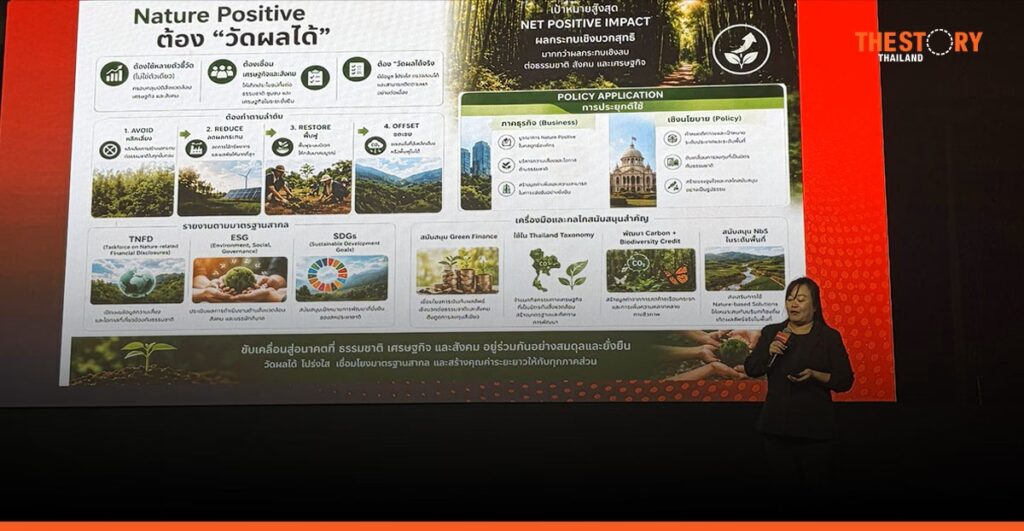
Dr. Pornpimon Boonkum highlighted that Nature Positive goes beyond environmental concerns; it is a crucial strategic approach for the future of business. All industries rely on natural resources and ecosystem services such as water, raw materials, energy, climate regulation, and biodiversity. Ecosystem degradation directly affects production efficiency, costs, competitiveness, and long-term business sustainability.
The Nature Positive concept goes beyond just decreasing environmental harm; it focuses on restoring ecosystems to to a state of abundance and thriving health. It supports global goals to stop biodiversity loss by 2030 and achieve nature recovery by 2050 through science-based, measurable actions aligned with international standards. These actions also inform financial investments. A crucial aspect is nature impact measurement (Nature Measurement), which is central to Nature Positive efforts. Organizations should start by evaluating their actual impacts and follow a clear hierarchy: avoid impacts (Avoid), reduce impacts (Reduce), restore ecosystems (Restore), and offset any remaining impacts (Offset). Offsetting should be the last resort, only after implementing all other measures.
Furthermore, the shift towards Nature Positive is opening new business prospects for both large corporations and startups. These include developing data platforms, monitoring and evaluating biodiversity impacts, establishing traceability systems, developing monitoring tools, and applying digital technologies to facilitate reporting under frameworks like TNFD, ESG, and the SDGs. These capabilities will enhance business competitiveness in the future. Dr. Boonkum also shared examples of Nature Positive applications across various sectors such as construction materials, energy, agriculture and food, and tourism, along with strategies to add value to community products and resources. By combining data, technology, and innovation, these initiatives link the conservation of natural resources with income generation and sustainable local economic growth.
Dr. Pornpimon Boonkum’s invitation as a speaker reflects the role of MTEC, NSTDA as a research organization with expertise in technologies and innovations for sustainable development. MTEC remains committed to supporting the practical application of knowledge and technology to help businesses and Thai society achieve growth that balances economic, social, and environmental dimensions in line with the Nature Positive concept.