
K. S. P. OCTATECH CO., LTD.
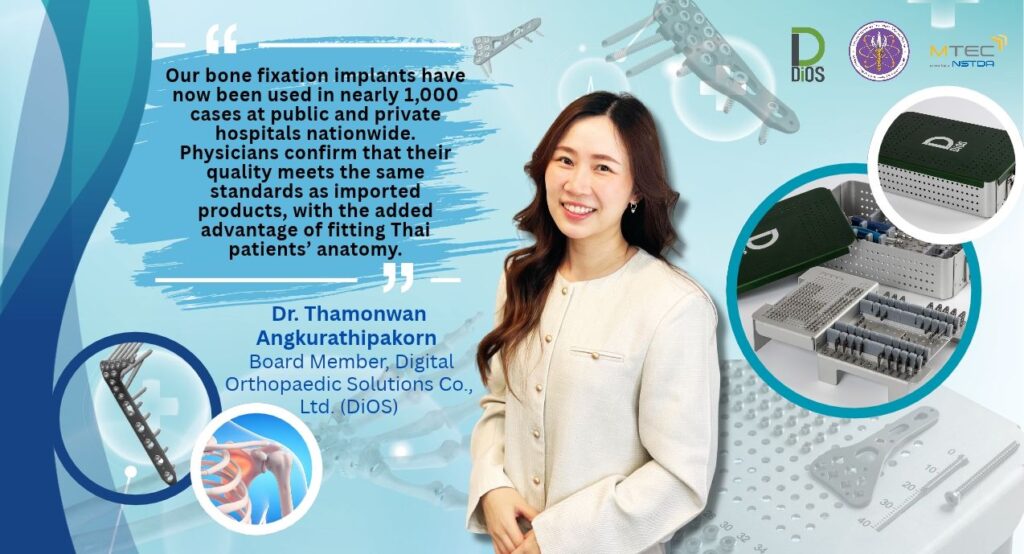
“Our bone fixation implants have now been used in nearly 1,000 cases at public and private hospitals nationwide. Physicians confirm that their quality meets the same standards as imported products, with the added advantage of fitting Thai patients’ anatomy.”
Dr. Thamonwan Angkurathipakorn
Board Member, Digital Orthopaedic Solutions Co., Ltd. (DiOS)
Knowledge Communication and Mobilization Section
Materials Technology Knowledge Dissemination Division
From a Public Health Challenge to an Operating Room Pain Point
Thailand’s medical device industry today is focused not only on developing new research in the laboratory, but also on translating innovation into practical use within the public health system. Bone fixation plates and screws, in particular, are essential medical devices for treating accident-related fractures and rank among the highest-value reimbursement items under government health funds, totaling more than THB 1 billion per year.
The National Metal and Materials Technology Center (MTEC), under the National Science and Technology Development Agency (NSTDA), collaborated with three leading Thai medical institutions—Siriraj Hospital, Thammasat University Hospital, and Songklanagarind Hospital—as well as Digital Orthopaedic Solutions Co., Ltd. (DiOS), to develop innovative locking plates and locking screws designed specifically for Thai anatomy.
Dr. Thamonwan Angkurathipakorn, a board member of DiOS, recalled the project’s beginnings. The company initially focused on developing orthopedic medical devices and experimented with 3D-printed products and patient-specific customization. Although this work served research purposes well, it could not fully meet broader market demand. After consulting medical specialists and analyzing reimbursement data from the National Health Security Office (NHSO), the team found that locking plates and locking screws were among the country’s highest-value reimbursable medical devices.
In the past, all products in this category had to be imported. A frequent problem was anatomical mismatch: the dimensions and shapes of imported devices did not conform well to Thai anatomy. Surgeons therefore had to spend time bending and shaping the plates in the operating room to fit each patient’s bones. MTEC researchers, the medical teams, and the company jointly analyzed Thai anatomical data and used it in the design process to create devices that directly address this pain point.
The Science of Anatomical Design and International Standards
The development of this innovation drew on the specialized expertise of orthopedic surgeons for different parts of the body, resulting in products for four key anatomical sites. These include a distal radius plate with an especially low-profile design to reduce soft-tissue irritation, and a proximal humerus, or shoulder, plate with screw positioning that helps distribute loads. Variable Locking technology also enables secure bone fixation during surgery.
The portfolio also includes a distal femur plate whose curvature conforms to the bone structure, reducing the time required to bend the device in the operating room, and a proximal tibia plate with lateral grooves that reduce unnecessary contact with the bone. All products have been registered as medical devices with the Thai Food and Drug Administration under the Full Common Submission Dossier Template (Full CSDT) pathway. They have also completed international-standard testing for mechanical strength and biocompatibility, while the manufacturing facility is certified to ISO 13485.
Real World Use Challenges and International Market Opportunities
DiOS bone fixation implants have now been used to treat patients in more than 700 cases at over 20 hospitals nationwide. These include leading teaching hospitals and medical centers such as Siriraj Hospital, Thammasat University Hospital, Phramongkutklao Hospital, Golden Jubilee Medical Center, and Khon Kaen Hospital, as well as private hospitals such as Bumrungrad International Hospital and Synphaet Hospital. Physicians using the products have reported that their quality standards are comparable to those of imported alternatives and that they significantly reduce operating-room time.
Despite their successful clinical adoption, Thai medical device innovations still face major marketing challenges. These include physicians’ familiarity with long-established foreign brands, price competition from certain lower-cost imported products, and complex hospital procurement requirements. Therefore, advancing a centralized procurement mechanism or conducting innovation pilot projects with the NHSO would help public hospitals gain easier access to Thai innovations.
The innovation’s journey has also received continued support from MTEC’s Biofunctional Materials and Devices Research Group and from NSTDA. Together, they have provided comprehensive support through research and development, technology transfer, medical network building, and public communication that strengthens credibility. At the same time, this experience underscores the need to translate public procurement policy into concrete action so that Thai innovations can enter hospitals on a broader scale.
The next step to watch is international market expansion. Comparative anatomical data indicate that Thai and other Asian populations have highly similar bone structures. DiOS is therefore planning to export its products to ASEAN markets, initially targeting countries such as Malaysia and Indonesia, while also preparing to enter the major Japanese market. The company has received funding to develop a quality control system that meets export standards. Taken together, these developments show that medical device innovations designed and manufactured by Thai people can not only reduce dependence on imported medicines and medical devices, but also mark an important step toward strengthening Thailand’s medical capabilities and achieving sustainable health security.